Robot Can Now Learn Surgery Just by Watching Videos: The Future of Autonomous Medical Intelligence
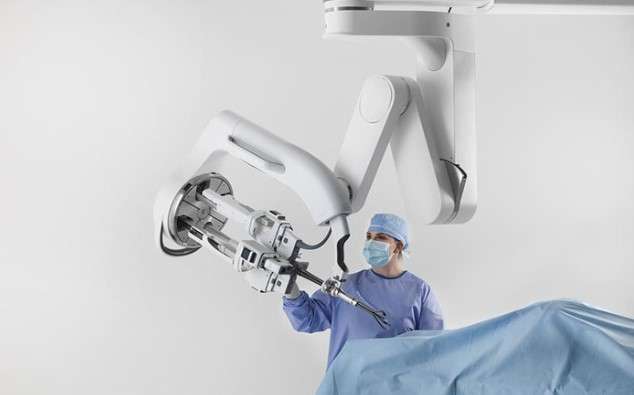
A Breakthrough in AI-Driven Surgical Learning
We are witnessing a transformational leap in medical technology, where robots are no longer limited to pre-programmed instructions. Instead, they are now capable of learning complex surgical procedures simply by watching videos. This advancement represents a fundamental shift from traditional robotic systems toward adaptive, intelligent machines that can observe, interpret, and replicate human expertise with remarkable precision.
Unlike earlier generations of surgical robots that relied heavily on manual coding and rigid algorithms, this new approach leverages imitation learning—a method where artificial intelligence models analyze visual data to understand motion, sequence, and intent. By processing hundreds of real surgical recordings, these systems develop the ability to perform intricate tasks without step-by-step programming.
How Robots Learn Surgery from Visual Data
We now see the emergence of vision-based AI models trained on surgical footage captured from robotic-assisted procedures. These models analyze movement patterns, tool interactions, and spatial relationships within the human body. Instead of interpreting language, the AI focuses on kinematics, which refers to the motion and coordination of surgical instruments.
Through repeated exposure to high-quality surgical videos, the robot builds an internal representation of how procedures are performed. This allows it to execute actions such as needle handling, tissue manipulation, and suturing with increasing accuracy. The system does not merely mimic; it understands context, enabling smoother and more reliable performance.
Precision Tasks Once Reserved for Human Experts
One of the most striking aspects of this innovation is the robot’s ability to perform high-precision surgical tasks that typically require years of human training. These include:
Delicate suturing techniques that demand steady hands and precise timing
Coordinated instrument handling in confined surgical environments
Dynamic tissue interaction where responsiveness is critical
We observe that the robot’s consistency often exceeds human capability in controlled environments. By eliminating fatigue and variability, the system delivers stable, repeatable outcomes, which is essential in high-stakes medical procedures.
Self-Correction: A New Standard in Robotic Intelligence
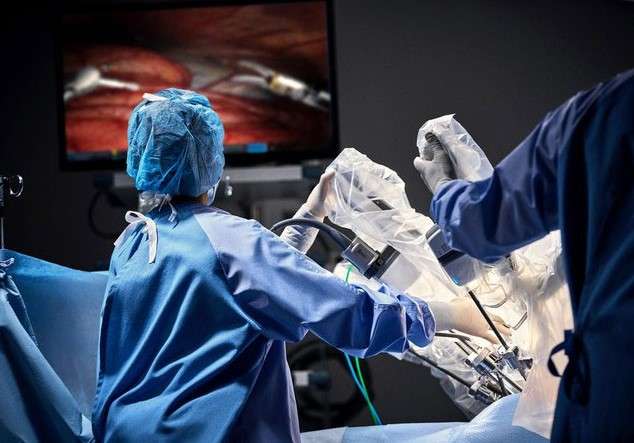
Beyond imitation, we recognize a defining feature of this technology: autonomous error correction. When a mistake occurs—such as dropping a surgical needle—the robot can identify the issue and resolve it independently. This capability marks a departure from traditional robotics, where unexpected scenarios often require human intervention.
The system continuously evaluates its own actions against learned patterns. When deviations are detected, it adjusts in real time. This creates a feedback loop that enhances both accuracy and reliability, moving robotic surgery closer to true autonomy.
Integration with Advanced Surgical Platforms
This breakthrough is being developed alongside state-of-the-art robotic surgical systems, which already provide enhanced visualization and precision. By integrating AI-driven learning models into these platforms, we unlock the potential for semi-autonomous and eventually fully autonomous surgical procedures.
The synergy between robotic hardware and intelligent software allows for seamless execution of complex operations. Surgeons remain essential, but their role evolves toward supervision and strategic decision-making, rather than direct manipulation of instruments.
Transforming Surgical Training and Healthcare Accessibility
We are entering an era where training time can be dramatically reduced. Instead of requiring years of hands-on practice, surgical expertise can be accelerated through data-driven learning systems. This has profound implications for global healthcare.
Regions facing a shortage of skilled surgeons can benefit from AI-assisted procedures, improving access to high-quality medical care. Additionally, standardized robotic performance ensures consistent outcomes across different environments, reducing disparities in treatment quality.
Challenges and the Path Forward
While the progress is extraordinary, the technology remains in a developmental stage. Current testing environments are controlled, and further validation is required before widespread clinical adoption. Safety, regulatory approval, and ethical considerations must be addressed with precision.
However, the trajectory is clear. With continued advancements in machine learning, computer vision, and robotics, we are steadily moving toward a future where intelligent machines play a central role in surgery.
The Future of Autonomous Surgery
We stand at the forefront of a new medical paradigm. Robots that can learn from observation are not just tools; they are becoming partners in healthcare delivery. As these systems evolve, they will redefine what is possible in surgical precision, efficiency, and accessibility.
The ability for a robot to learn surgery by watching videos is more than a technological milestone—it is a glimpse into a future where human knowledge can be scaled, replicated, and enhanced through artificial intelligence.

Related Posts

AI Could “Change Things in a Terrifying Way”: A Deep Analysis of the Risks, Power, and Future of Artificial Intelligence

Why Can the Moon Be Considered a Planet? A Scientific Reassessment of Planetary Definition