AI and the 21st-Century Mona Lisa: How Artificial Intelligence Reimagines a Masterpiece
For more than 500 years, Leonardo da Vinci’s Mona Lisa has stood as the most famous painting in the world—captivating audiences with its enigmatic smile and subtle mastery of form and light. Today, advances in artificial intelligence (AI) are not only studying this masterpiece but also reimagining it for the 21st century. Through neural networks, generative models, and image synthesis technologies, AI is transforming how we interpret, analyze, and recreate classical art.
In this article, we’ll explore how AI reshapes the Mona Lisa, what this means for art and culture, and why this technological renaissance matters to both art lovers and technologists alike.
1. The Legacy of the Mona Lisa
Before diving into AI’s role, it’s essential to understand why the Mona Lisa remains so iconic. Painted by Leonardo da Vinci between 1503 and 1506, the portrait is celebrated for its:
- Ambiguous expression
- Innovative use of sfumato (a technique that blends tones and colors)
- Psychological depth
The painting has inspired centuries of analysis and debate, with scholars and scientists alike attempting to decode its secrets.
2. Enter Artificial Intelligence: A New Lens on Old Masterpieces
Artificial intelligence has revolutionized image processing and generation. Using algorithms like generative adversarial networks (GANs) and deep learning, computers can now:
- Analyze brushstrokes and composition
- Identify patterns invisible to the human eye
- Generate new, stylistically consistent images
AI doesn’t just replicate images—it learns from vast datasets of art to create novel variations that reflect artistic styles, emotions, and aesthetics.
3. What Would the Mona Lisa Look Like Today? AI’s Answer
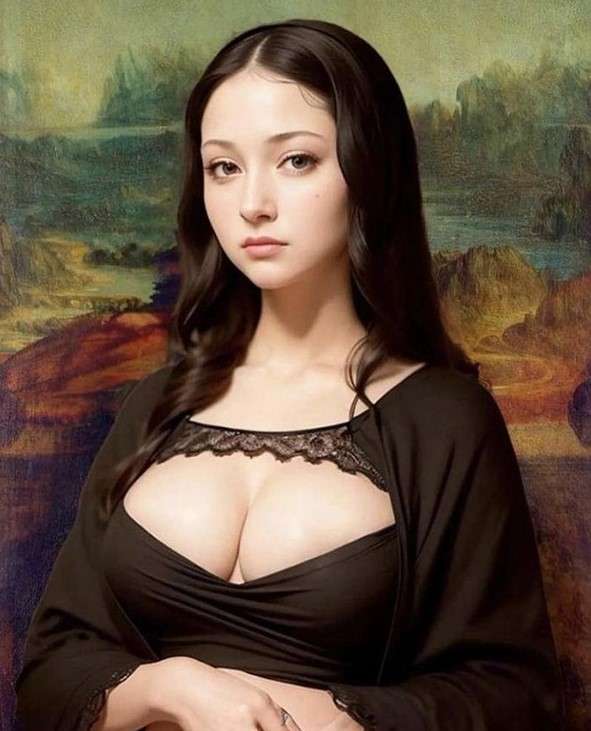
The Vietnamese article you shared discusses an AI-generated version of the Mona Lisa imagined for the 21st century. According to that piece, AI produced a reinterpretation where:
- The woman’s eyes appear larger and blue
- Her nose is smaller
- Her eyebrows are more defined
- Facial features are adjusted to match modern beauty norms
Some social media users were surprised or even unsettled by the result, questioning whether AI was improving the original or simply imposing contemporary aesthetics.
This variation sparked discussion because it highlighted a key point: AI interpretations reflect the data they’re trained on. When AI models learn from contemporary images and cultural standards, they tend to reproduce those patterns—even when applied to Renaissance art.
4. AI and Artistic Interpretation: Science or Bias?
AI models don’t understand art the way humans do. Instead, they detect statistical patterns. This has important implications:
a. AI Reveals Hidden Patterns
Advanced AI analysis can uncover details that elude human perception. For example, a computational art study used machine learning to analyze Leonardo’s shadow placement, revealing a complex system of emotional cues embedded in the Mona Lisa’s expression. This approach treated the painting as a perceptual algorithm, suggesting that Leonardo intentionally engineered emotional ambiguity.
b. AI Can Reflect Cultural Biases
When AI is trained on modern datasets, it may project contemporary beauty standards onto historical subjects—raising questions about authenticity and interpretation. This was evident in the AI-generated 21st-century Mona Lisa.
c. AI Doesn’t Replace Human Insight
Despite AI’s power, experts caution that machine analysis lacks context, intuition, and cultural understanding. As a recent discussion on AI and art history notes, AI can support hypotheses but cannot fully replace the nuanced judgment of human scholars.
5. AI-Generated Art: Creative Tool or Artistic Threat?
The rise of AI art raises broader questions:
a. Creativity Redefined
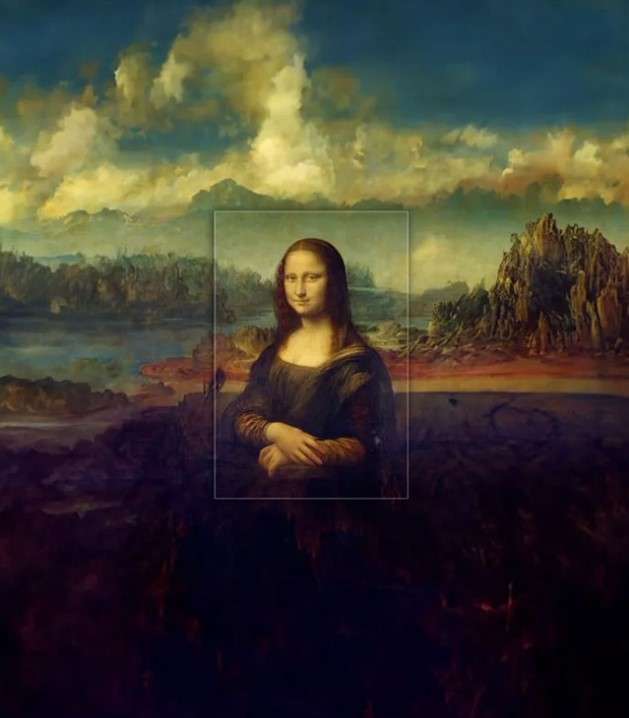
AI is not simply a tool—it’s becoming a creative collaborator. Artists and technologists are using AI to generate new styles, experiment with form, and push the boundaries of visual expression. This includes AI-generated animations of the Mona Lisa and other classical works, where neural networks create dynamic expressions or motion from static images.
b. Ethical and Philosophical Debates
Who owns an AI-generated work? Is it the programmer, the dataset, or the machine itself? These questions are at the heart of debates about creativity, originality, and artistic value.
c. Public Engagement
AI interpretations of famous works often go viral on social media, sparking conversation among people who might never otherwise engage with art history. The Mona Lisa trend online, for example, has generated memes, debates, and creative remixes—bringing the painting into popular culture in new ways.
6. Technical Foundations: How AI Interprets Art
Understanding how AI works can help demystify its role in art:
a. Neural Networks
AI models like convolutional neural networks (CNNs) analyze visual patterns by learning from thousands (or millions) of images.
b. Generative Models
GANs consist of two competing networks—one generates images, and the other evaluates them—leading to increasingly realistic outputs.
c. Training Data Matters
The quality and diversity of training data directly influence the AI’s output. When models are trained on modern images, they may project contemporary aesthetics onto historical subjects.
This technical foundation is why AI can recreate a 21st-century Mona Lisa that looks very different from the original.
7. The Future of AI and Art
a. Preservation and Restoration
AI is being used to reconstruct damaged art, predict missing elements, and even simulate how paintings might have looked originally.
b. Education and Accessibility
AI tools can help museums and educators create interactive experiences, making art more accessible to global audiences.
c. New Artistic Movements
Just as photography gave rise to new art forms in the 20th century, AI is inspiring a new generation of artists who blend technology with traditional practice.
8. What This Means for Art Lovers and Creators
Whether you are an artist, a student, or a casual admirer of art, AI’s influence on the Mona Lisa and other masterpieces offers valuable insights:
a. Art Is Not Static
Every generation reinterprets art through its own lens—AI simply accelerates this process.
b. Technology and Culture Intersect
AI challenges us to think about how culture, data, and technology shape our perception of beauty and meaning.
c. Engage Critically
AI art should be appreciated and questioned. Understanding how algorithms work helps us see beyond surface aesthetics to deeper cultural implications.
9. Conclusion: A New Renaissance
The Mona Lisa has always been more than a painting—it is a cultural icon, a subject of mystery, and a mirror of human curiosity. With AI, we are not just analyzing this masterpiece—we are participating in a new form of artistic dialogue.
AI’s reinterpretation of the Mona Lisa for the 21st century highlights both the power and limitations of machine creativity. It reveals that art and technology are not opposing forces but partners in exploring what it means to see, create, and understand.
As we continue to push the boundaries of AI, the Mona Lisa remains a timeless reminder that art reflects not just the skill of its creator, but the imagination of its audience—whether human or machine.